

EU Tightens ADR Inspections: New Rules for the Transport of Dangerous Goods

Starting 2nd November 2025, a new Delegated Directive (EU) 2025/1801 will come into effect, introducing harmonised ADR inspection procedures across all EU member states. The directive brings a unified inspection checklist, a new system for classifying risk levels, and clearer accountability throughout the entire dangerous goods supply chain.
These changes mean that carriers, shippers, and logistics operators will need to review and update their internal safety procedures, staff training, and documentation processes.
A New Framework for ADR Checks
The new directive updates Annexes I and II of Directive (EU) 2022/1999, aligning European rules with the most recent ADR amendments and UN recommendations on dangerous goods transport.
Its core aim is to standardise how ADR inspections are carried out, ensuring consistency, transparency, and improved safety standards across the European Union.
Key Operational Change: The Unified Checklist
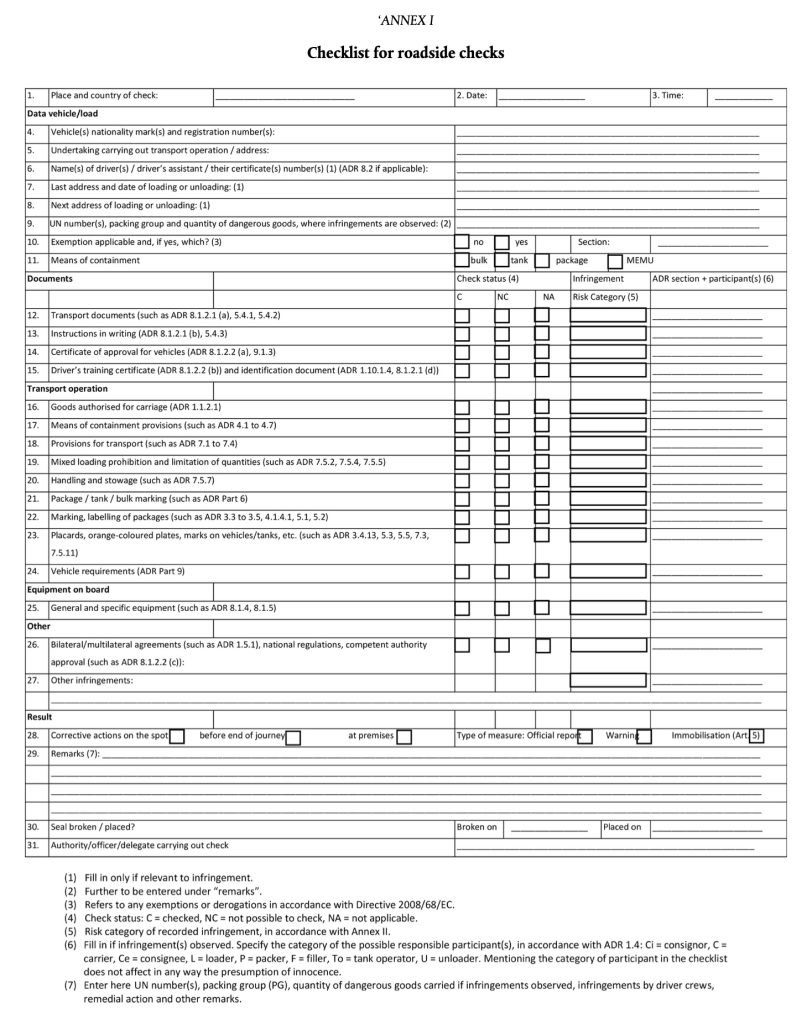
A new mandatory inspection checklist will now be used by all enforcement authorities across member states.
The checklist covers:
-
Vehicle, tank, and container compliance
-
Documentation and approval certificates
-
Safety and emergency equipment requirements
Each item on the checklist references a specific ADR clause, guaranteeing that inspections are applied uniformly across Europe.
Three Risk Categories for Violations
The directive introduces a three-tier system for classifying non-compliance:
-
Category I – High Risk: Immediate danger (e.g. leaks, missing ADR certificates, serious safety breaches) requiring the vehicle to be stopped.
-
Category II – Medium Risk: Issues that must be corrected immediately (e.g. faulty fire extinguishers, incorrect markings).
-
Category III – Low Risk: Minor or formal errors that can be corrected later without major safety impact.
Expanding Responsibility Along the Supply Chain
Responsibility for ADR compliance will now be shared more explicitly across all parties in the logistics chain — including shippers, carriers, loaders, packers, fillers, consignees, and tank operators.
Each party must ensure their part of the transport process meets ADR standards, helping to eliminate ambiguity over who is accountable in the event of a violation.
Documentation and Digital Access
All required ADR documentation — including driver training certificates, vehicle approvals, and written safety instructions — must be readily available in the vehicle cabin.
Digital copies are permitted, provided they are immediately accessible and verifiable during inspections. Missing or incomplete documentation could lead to vehicle detention or fines.
What It Means for Industry
With the new directive, logistics companies must:
-
Review and update internal ADR procedures and driver training
-
Verify that transported materials align with the new risk categories
-
Ensure ADR advisor obligations and documentation are current
-
Adapt systems to handle electronic documentation securely
Linked to ADR 2025 Updates
Directive (EU) 2025/1801 also references changes coming in ADR 2025, such as:
-
New UN numbers and hazard classifications
-
Updated compatibility tables
-
Revised thresholds for substances like lithium batteries, lead compounds, and metal waste
Member states have until June 23, 2026 to implement the new directive. The harmonised inspection system will become mandatory from June 24, 2026.
These reforms mark one of the most significant steps in recent years to improve safety, accountability, and transparency in the transport of dangerous goods across Europe.
See the link for the Delegated Directive (EU) 2025/1801

