Hibiscus is pleased to introduce Peter Bremble, Safety Training Specialist at DEKRA, as a guest blog contributor. Peter brings a wealth of experience in process safety testing, with particular expertise in combustible dust hazards across sectors including food, agriculture and chemicals. In this article, he explores why materials like grain dust — often perceived as low-risk — can in fact pose serious fire and explosion hazards if not properly assessed and managed. Drawing on real-world data and testing methodologies, Peter outlines the key thermal behaviours to monitor during drying and storage operations, and explains how specialist testing can inform safe temperature limits and compliance with Dangerous Substances & Explosive Atmospheres Regulations (DSEAR).
Beyond the Surface: The Thermal Hazards of Grain and Agricultural Dusts
When assessing the risks of handling and processing, many food and agriculture dusts are often seen as relatively safe – after all, they’re not toxic or corrosive. However, these materials are among the most powerful fuel sources in fires and explosions, contributing to 30 injuries and 12 fatalities in 2023 internationally (excluding the United States and Canada).
Whether drying, conveying or storing, grain dust is one of the main fuel sources involved in fires and explosions in the UK (2023), with the risk of fires when drying and storing being the most prevalent.
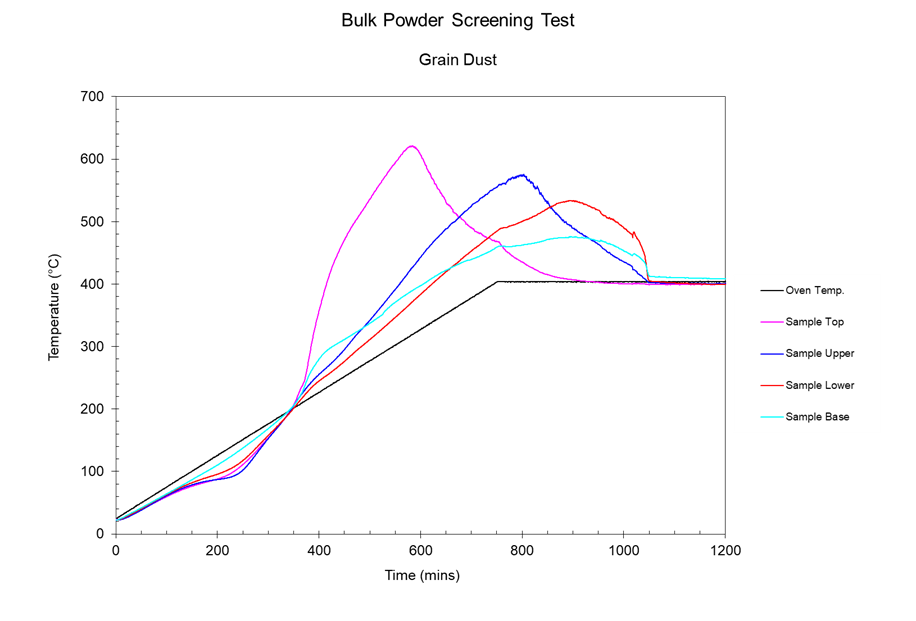
One cause of fires during drying operations is the use of incorrect drying temperatures. Accurate thermal stability data needs to be obtained to ensure that during the drying process the material does not start to self-heat causing fires which, in turn, could progress to an explosion if the finer grain dust was roused as a dust cloud.
Once this data is obtained, a suitable safety factor should be applied, taking into consideration the accuracy of the drier’s temperature controls. The drying temperature of the process can then be set appropriately. Normal and abnormal conditions should be considered when setting drying temperatures.
Figure 1. Example of Bulk Powder Screening Test
General storage in silos can also result in fires and explosions due to self-heating in large bulk. Materials in bulk can start to self-heat when the material in the middle cannot lose heat to the environment. Given enough time this can lead to a runaway reaction causing fires and explosions in silos.
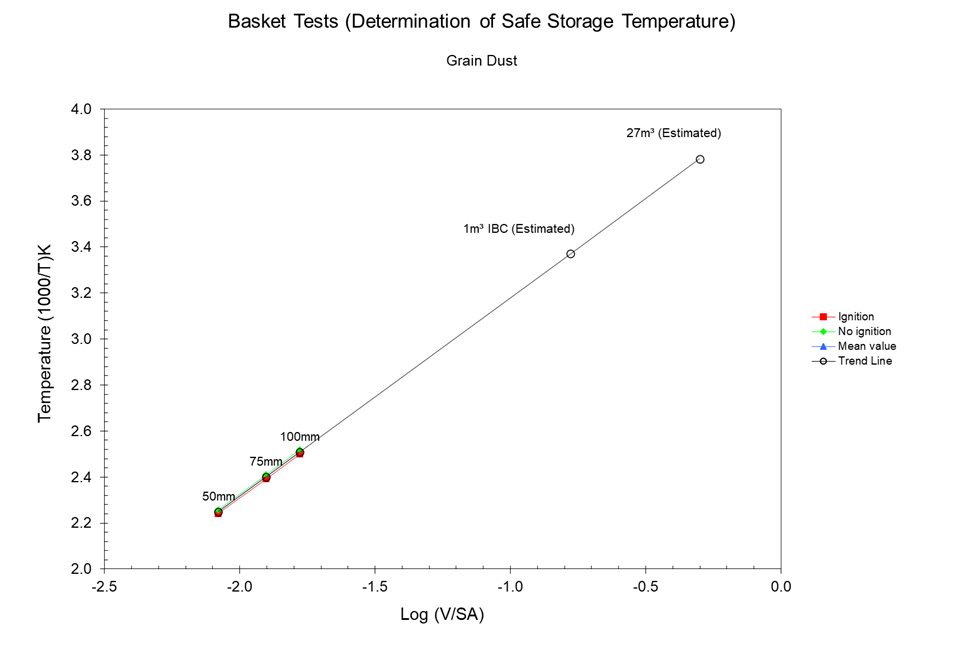
Testing can be carried out to determine the safe storage temperature by measuring the ignition temperature in containers of varying sizes, then extrapolating the results to match the size and geometry of the specific silo or storage vessel.
Figure 2. Example of Safe Storage Temperature Extrapolation
There are many other potential causes of fires and explosions when handling grain dust. Any operation or process handling a combustible dust comes under the DSEAR legislation.
Risk assessments should be conducted to identify the likelihood and risk of flammable atmospheres and potential ignition sources related to the operation. After all risks have been assessed and documented, a suitable and robust Basis of Safety for the operation should be defined.
DEKRA offer expert technical support and a full range of testing services through our state-of-the-art, purpose-built laboratories.
If you have any questions or concerns related to the topic above, don’t hesitate to get in touch with the DEKRA Organisational & Process Safety team.