

CLP Labelling Update: What Businesses Need to Know
At CHEMUK 2026, one of the biggest regulatory topics remains the ongoing evolution of the EU Classification, Labelling and Packaging (CLP) Regulation. While many businesses spent the last year preparing for extensive new label formatting requirements, recent legislative developments have changed the timetable — but not the destination.
The New CLP Label Rules Are Delayed, Not Cancelled
Regulation (EU) 2024/2865 introduced stricter requirements for chemical labels, including:
- Minimum font sizes based on package size
- Mandatory black text on a white background
- Standardised layouts and formatting
- Increased line-spacing and readability requirements
These changes were designed to improve hazard communication and consistency across the supply chain. However, under Regulation (EU) 2025/2439, many of these requirements have now been postponed until 1 January 2028.
The delay applies to label formatting, readability provisions, online advertising and distance-selling obligations, fuel pump labelling, and certain relabelling timelines.
Importantly, this is a delay, not a cancellation. The requirements remain in law and businesses should treat 1 January 2028 as a fixed compliance deadline.
What Hasn’t Changed?
While the formatting requirements have been pushed back, core CLP obligations remain fully in force, including:
- Classification of substances and mixtures
- Hazard communication requirements
- Downstream user responsibilities
- Poison Centre Notification (PCN) and UFI obligations
In addition, the new hazard classes introduced under Regulation (EU) 2023/707 are already enforceable. These include:
- Endocrine Disruptors (ED)
- Persistent, Bioaccumulative and Toxic (PBT/vPvB)
- Persistent, Mobile and Toxic (PMT/vPvM)
The Next Key Deadline: November 2026
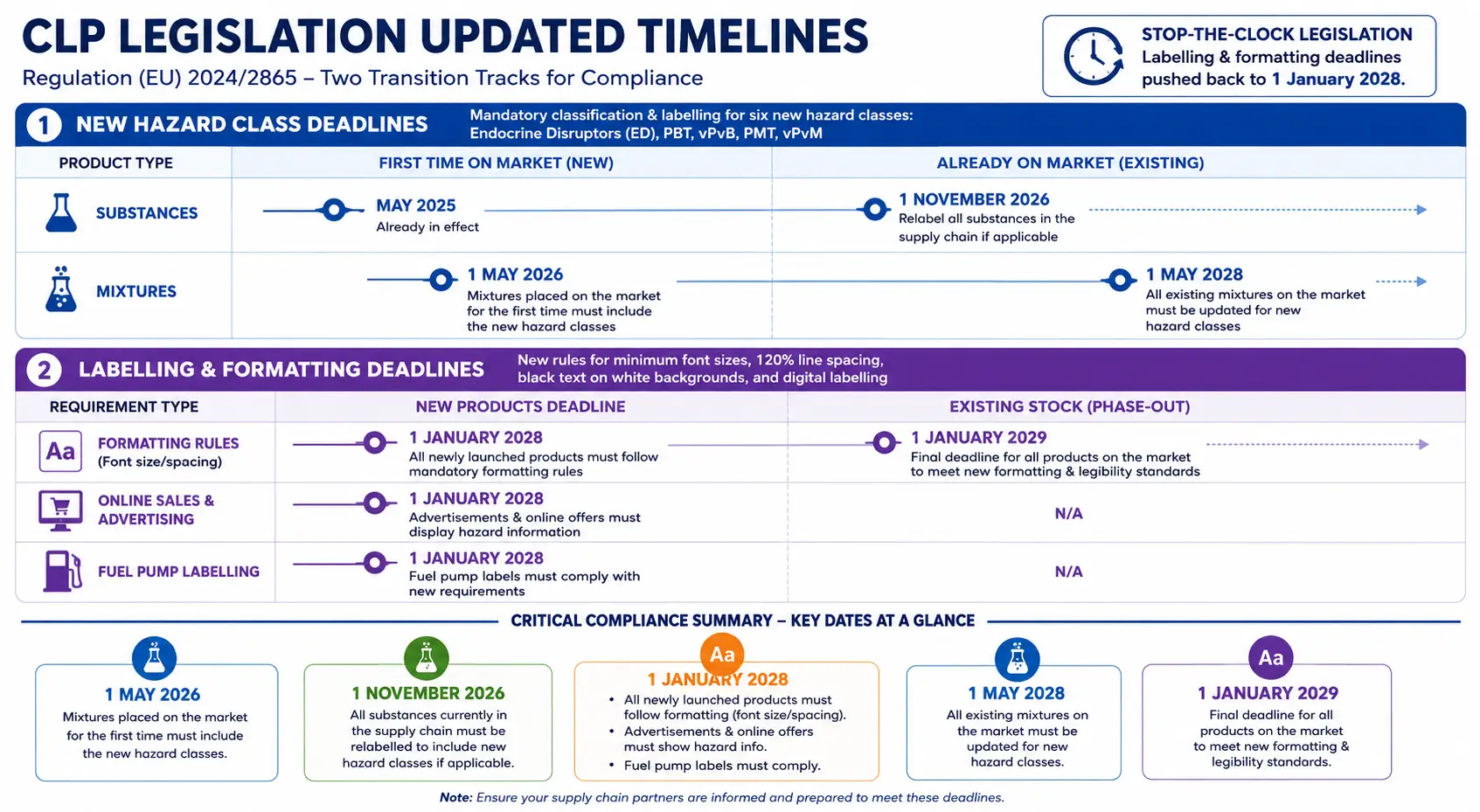 A major milestone arrives on 1 November 2026, when all substances already on the EU market must be assessed against the new hazard class criteria.
Where classifications change, businesses may need to:
- Update Safety Data Sheets (SDSs)
- Reassess affected mixtures
- Revise labels and hazard communication materials
For organisations with extensive product portfolios, preparation should already be underway.
Omnibus VI: Still One to Watch
Alongside the delay, discussions continue under the EU’s Omnibus VI simplification package. While future negotiations may adjust some requirements, the current implementation date of 1 January 2028 remains unchanged.
Businesses should therefore plan based on the existing legislation while monitoring further developments.
Use the Extra Time Wisely
The extension to 2028 provides valuable breathing space, but it should be used proactively. Companies should focus on:
- Reviewing labelling and artwork management systems
- Assessing packaging designs, particularly for small-format products
- Integrating classification data with label generation processes
- Preparing for faster label updates and compliance changes
- Strengthening supplier data management and regulatory oversight
- Evaluating online sales and advertising compliance requirements
Key Takeaways
- The new CLP formatting rules have been delayed until 1 January 2028, not cancelled.
- Core CLP obligations and new hazard classes remain fully enforceable.
- 1 November 2026 is the next major compliance milestone for substance classification reviews.
- Omnibus VI may alter details of the legislation, but the 2028 implementation date remains fixed.
- Early preparation will help avoid costly redesigns, supply chain disruption, and last-minute compliance challenges.
The message for industry is clear: use the additional time to prepare, modernise systems, and build flexibility. Those who act now will be in the strongest position when the new requirements finally come into force.

