

When it comes to the labelling of dangerous goods, sometimes, the smallest details make the biggest difference — and nowhere is that more true than in aviation safety.
The Cargo Aircraft Only (CAO) label is a perfect example: a small graphic with a few words, yet it can prevent major incidents if designed, and understood, correctly.
Origins: 1974 – The Danger Era
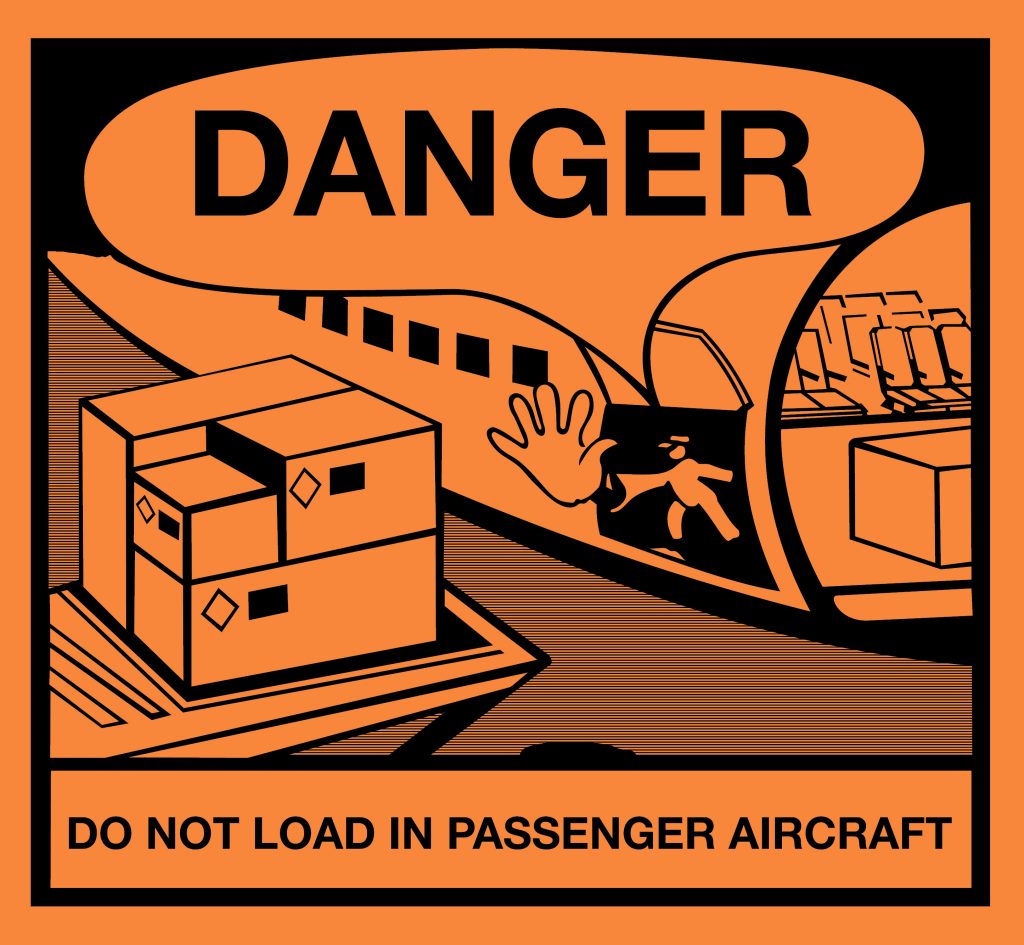
Back in 1974, the CAO label made its debut in the 17th edition of the IATA Restricted Articles Regulations. It shouted one word at handlers: “Danger.” Bold, clear, and alarming — the label certainly caught attention.
For nearly 40 years, this design guided cargo handlers, becoming a familiar part of air freight operations.
The specifics of the label are pretty simple: it must be rectangular and a minimum size of 120x110mm (these dimensions may be halved but only for small packages of Divison 6.2 Infections Substances),
The printed text and images should be black on an orange (Pantone 151, Uncoated stock) background and the label must be exactly as shown in the IATA Dangerous Goods Regulations Figure 7.4..B in 7.4.2
The label must be displayed on the same surface of the package that contains the hazard labels
Old CAO Label (1974–2012)
Original CAO label with “Danger” wording
When Danger Wasn’t Enough
Despite its bold design, the label had serious shortcomings. The original version displayed only the word “Danger”, which was open to being misunderstood by busy airline staff. Workers who were never meant to decide what counted as dangerous goods sometimes treated the label as a vague caution rather than a strict operational instruction.
In the rush of handling hundreds of packages, a handler might see “Danger” and assume it was a general warning — not a directive with safety implications. The consequence was that hazardous cargo ended up being loaded onto passenger aircraft.
Investigations revealed the root problem: the label warned, but failed to clarify. It did not give explicit instruction that the item was restricted to Cargo Aircraft Only.
To address this, regulators proposed redesigning the label to make its meaning clearer.
2013 – A Word Makes All the Difference
Fast forward to 1st January 2013.
IATA rolled out the revised CAO label. The update was deceptively simple: replace “Danger” with the clear instruction “Cargo Aircraft Only.”
It was changed from “DO NOT LOAD IN PASSENGER AIRCRAFT” to FORBIDDEN IN PASSENGER AIRCRAFT.
The change brought immediate clarity, ensuring handlers could quickly recognise the restriction.
It improved safety by reducing the risk of mis-loading, and the old label was officially retired.
New CAO Label (2013–Present)
Revised CAO label with “Cargo Aircraft Only” wording

The Ripple Effect of Small Changes
It might seem like a minor tweak — one word swapped for a few others — but the impact was significant. Mis-loading hazardous cargo can have catastrophic consequences, and this tiny label change dramatically reduced that risk.
It also sent a broader message: effective safety communication isn’t just about making things bold or alarming; it’s about being precise and unambiguous. A small, well-chosen word can prevent major errors.
Lithium Batteries: A Case Study in the Importance of the CAO Label
One particularly critical application of the CAO label is in the transport of lithium batteries by air. Lithium batteries are classified as dangerous goods because of their potential to overheat, catch fire, or even explode if damaged or improperly handled.
Because of these risks, lithium batteries are restricted to cargo aircraft under IATA and ICAO regulations in many cases. Here, the CAO label isn’t just a regulatory formality — it’s a crucial safety measure. Properly labelled packages ensure that handlers and flight planners are aware of the restrictions and take the necessary precautions to segregate, monitor, and manage these shipments safely.
A mis-labelled lithium battery package could lead to it being loaded on a passenger flight, creating a significant safety hazard. In this scenario, the CAO label’s explicit wording “Cargo Aircraft Only” is vital to prevent accidents and ensure the safe transport of high-risk goods.
Lessons from the Change
The CAO label case is a reminder that attention to detail matters. From the 1974 “Danger” label to the 2013 Cargo Aircraft Only design, a subtle change made air transport safer.
In safety-critical operations, it can be the little things — the tweaks, the clarifications — that can still have the biggest improvements.

